

The Port of Port Mansfield Becomes a Part of Foreign Trade Zone #12

Aerial view of the entrance to the Port of Port Mansfield
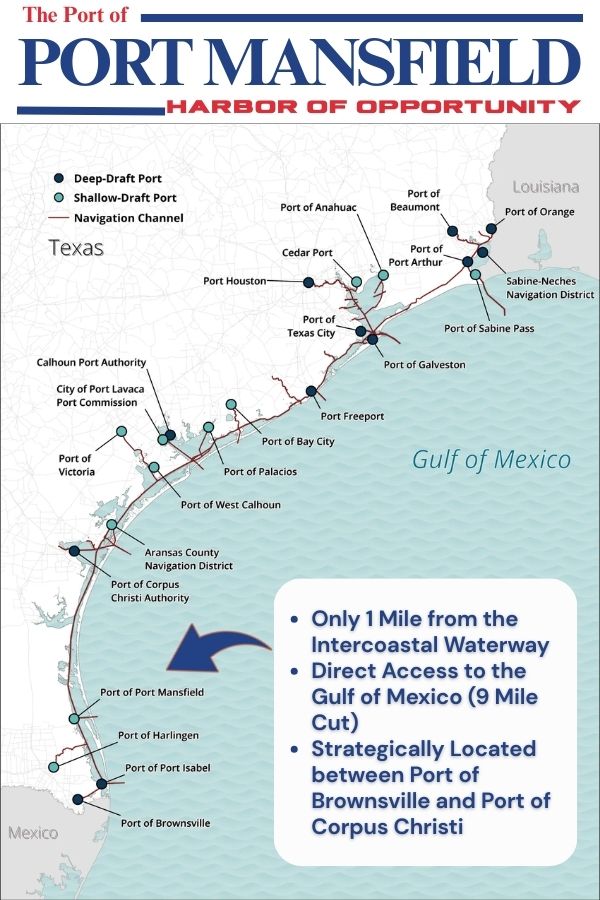
Port of Port Mansfield located between the Port of Corpus Christi and the Port of Brownsville, only 1 mile distance from the Intercoastal Waterway
An Open Harbor Ready for the Next Wave of South Texas Growth
RAYMONDVILLE, TX, UNITED STATES, October 30, 2026 /EINPresswire.com/ -- Along the Texas Gulf Coast, two of the Rio Grande Valley’s established ports are reshaping the regional economy. The Port of Brownsville has more than doubled its cargo volume, from roughly 13.9 million tons in 2021 to a sustained 28 million tons. Its ship channel now runs 52 feet deep, supporting more than $30 billion in pipeline projects, including the Rio Grande LNG terminal. The Port of Harlingen has grown more than 200 percent since 2017, driven by trade with Mexico, and is investing nearly $12.5 million in dock rehabilitation and navigation improvements.This growth is welcome. It creates jobs, strengthens supply chains, and raises South Texas’s profile. But it also creates pressure. Deep-water berths, channel capacity, and waterfront industrial land at the larger ports become more heavily used, wait times lengthen, and sites for barge traffic or lighter industrial operations grow harder to secure. Operators that do not need the deepest drafts start looking for alternatives.
That search is bringing serious attention to Willacy County and the Port of Port Mansfield.
Managed by the Willacy County Navigation District, Port Mansfield sits on the Gulf Intracoastal Waterway between Brownsville and Corpus Christi. It is not a deep-draft competitor to Brownsville, nor does it try to be. It is a shallow-draft harbor with restored access, substantial developable land, and a newly completed commercial staging dock and seawall, well suited to bulk materials, agricultural products, project cargo, and other goods that travel efficiently by barge.
The recent addition of Willacy County to the service area of Foreign-Trade Zone No. 12 strengthens that position. Under the Alternative Site Framework, eligible businesses in and around Port Mansfield can now pursue FTZ designation for their facilities. Goods can be admitted, stored, handled, or processed without immediate payment of U.S. duties and certain taxes. Duties are deferred until merchandise enters U.S. commerce and eliminated if goods are re-exported. Inventory held for export is generally exempt from state and local ad valorem taxes, and manufacturers may benefit from inverted-tariff relief when finished products carry a lower tariff than their imported components.
These advantages improve cash flow, reduce costs, and help companies keep value-added activity in the United States. Because FTZ No. 12 is an established zone, activating a site is relatively streamlined. The designation does not automatically convert every facility into a zone; companies must still apply, meet security and compliance standards, and, where production is involved, obtain appropriate authority.
That tool arrives alongside tangible infrastructure investment. The navigation channel has been restored to its authorized depth of approximately 17 feet from the jetties through the harbor and turning basin, funded through federal appropriations and executed by the U.S. Army Corps of Engineers. A new seawall and commercial staging dock, supported by Texas Department of Transportation Maritime Division funding and local partnership, was completed on time and within budget, providing roughly 380 to 400 feet of berth. The District also controls more than 1,500 acres of leasable upland. Together, these improvements answer the first question any operator asks: Can a vessel safely reach the dock, load or unload, and depart?
For Willacy County, the implications are straightforward. Legitimate commercial activity at the harbor can generate lease revenue, support local jobs in logistics and maintenance, and broaden the tax base without changing the community’s character. The FTZ option adds competitiveness that can attract tenants who might otherwise look only at larger, more congested ports.
This progress has not happened by accident. Willacy County Judge Aurelio Guerra and the WIllacy County Commissioners worked in unison to identify the potential benefits of the FTZ and put the plan in motion to acquire this designation.
"County Commissioners Court was thrilled to receive the notice from the U.S. Dept. of Commerce approving the expansion of Foreign-Trade Zone 12's service to Willacy County. This is a significant achievement for our county and places us in a stronger position to attract international trade, encourage investment, and job creation for our residents, in hope of a long-term resilient economy." - Aurelio Guerra, County Judge
The Willacy County Navigation District Commissioners have kept the focus on the harbor’s core mission: maintaining and improving the facility so it can serve commercial traffic while remaining accountable to the community that owns it. They have pursued federal and state funding rather than burdening local taxpayers, completed major projects through competitive bidding, environmental review, and partnership with the Army Corps of Engineers and TxDOT, and embraced the FTZ expansion as an added resource for economic development. The result is a port that can make a simple claim: the channel is restored, the dock is finished, and the pathway for trade advantages is open.
Ports succeed over the long term when leadership matches ambition to actual capacity, communicates clearly with residents and users, and prioritizes measurable improvements. The Commissioners’ emphasis on finishing infrastructure and securing outside funding treats growth as something earned through performance rather than announced in advance of capability.
The larger story in South Texas is expanding opportunity. Brownsville’s record volumes and Harlingen’s rapid growth show what investment and location can achieve, and they highlight the value of added capacity on the Intracoastal Waterway. Businesses seeking barge access, available land, and a cost structure improved by FTZ procedures are already examining Port Mansfield.
For the residents of Willacy County, this is a moment of practical possibility. The harbor is open, the investments are complete or well advanced, and county leadership has secured the Foreign Trade Zone designation. Continued progress depends on the same disciplined focus the Commissioners have shown: match tenants to the port’s strengths, maintain the channel and facilities, keep the process transparent, and measure success by the legitimate commercial activity that results. Port Mansfield is not a rival to its larger neighbors, but a complementary solution for businesses that need what it can actually deliver.
WCND Team
Willacy County Navigation District
+1 956-689-3332
oscar.montoya@willacynavigation.gov
Visit us on social media:
Instagram
Facebook
Legal Disclaimer:
EIN Presswire provides this news content "as is" without warranty of any kind. We do not accept any responsibility or liability for the accuracy, content, images, videos, licenses, completeness, legality, or reliability of the information contained in this article. If you have any complaints or copyright issues related to this article, kindly contact the author above.
