

The New Board Imperative: Governing What’s Next
Executive Summary
Today’s board directors are being asked to govern a broader and more dynamic set of issues, yet the core mandate is familiar. Set strategy, steward the business, choose leaders and oversee risk. AI, cyber threats, geopolitical and trade uncertainty and expanding regulation are increasing the complexity of those responsibilities and raising the premium on judgment.
Across 42 interviews with board directors in the U.S., UK and Canada, a consistent description emerged of the markets their companies are navigating. Faster, more interconnected, less patient. A corresponding analysis of board composition data over 15 years for the U.S. S&P 500, UK FTSE 100 and Canadian TSX 60 companies revealed how boards have been evolving and adapting to new pressures.
Boards are redesigning how they work.
- Boards continue to build capability around new demands. Risk and governance expertise is now credited to about half of U.S. and Canadian directors, while technology and sustainability are among the other areas showing significant gains. Directors acknowledge the squeeze on strategy time.
- As oversight demands squeeze strategy time, boards are becoming more disciplined about how they work, tightening agendas and materials, using committees more deliberately and shifting appropriate work between meetings to preserve space for strategic discussion.
AI fluency belongs in every board seat.
- AI fluency must extend across the board, not just in one seat. Boards are taking a range of approaches to building this capability across their directors and also acknowledge that expertise can sit beside them via advisory teams and experts that stay current as technology evolves.
- Boards are spending more time on AI, cyber and geopolitical issues and treating them as interconnected risks. Directors are reading the risk register across, not down, to understand intersection points and evaluate management preparedness.
The effective director brings more than expertise.
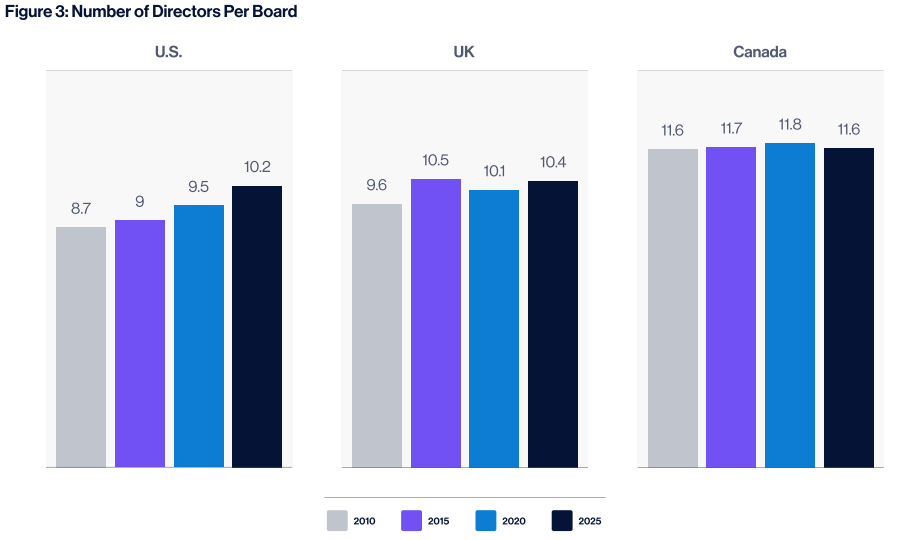
- Board size has changed only modestly across the three markets, even as the scope of the director role has broadened.
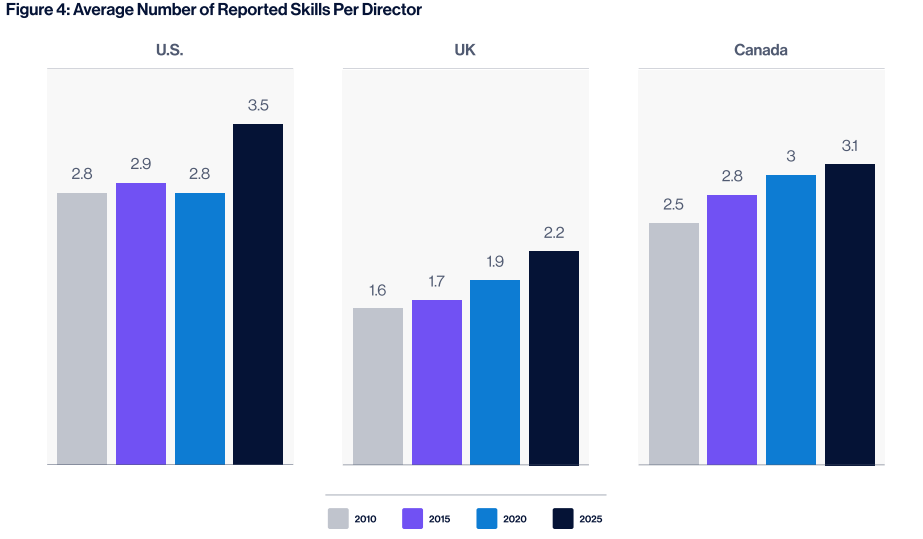
- The average U.S. director is now credited with 3.5 areas of expertise, up from fewer than 3 in 2010. Canada and the UK moved by nearly the same margin.
- Boards increasingly value the “utility player,” a director with depth in a particular area, but also the judgment, range and current operating experience to contribute across a wider agenda.
- That broader view of capability requires treating the skills matrix as a living tool, continually reassessing whether the expertise around the table remain relevant and current.
Succession is a system, not an event.
- The long term CEO is disappearing. As technology and persistent uncertainty reshape leadership requirements, boards are increasingly choosing leaders for a particular phase of a company’s development rather than assuming one profile will fit for the long term.
- Succession is therefore becoming a continuous, strategy led process. Boards are starting with where the business is going and what leadership that future will require, then looking earlier and further below the C suite to build visibility into potential successors.
- That also changes how candidates are assessed. Beyond experience and credentials, boards are placing greater weight on judgment, adaptability and how potential leaders perform through change.
Taken together, the findings point to a more deliberate board operating model, one that makes better use of each seat, each meeting and the expertise available around the table. These insights offer a practical roadmap for navigating strategic challenges and emerging risks now and in the future.
The Demands of an Expanding Agenda
Our interviews with directors across markets surfaced a consistent and familiar set of core board responsibilities. These are stewardship, regulatory obligations, corporate strategy, succession planning and oversight on behalf of shareholders. But while the broad mandate has remained stable, the conditions for delivering against it have not.
Expanding regulations, interconnected risks and technology acceleration are all cited reasons why board agendas are expanding. Agendas that centered on financial stewardship and management performance are making room for cyber, geopolitics, culture, sustainability and AI. Issues once handled by management now require board level response. Each topic adds breadth and complexity to what boards must oversee.
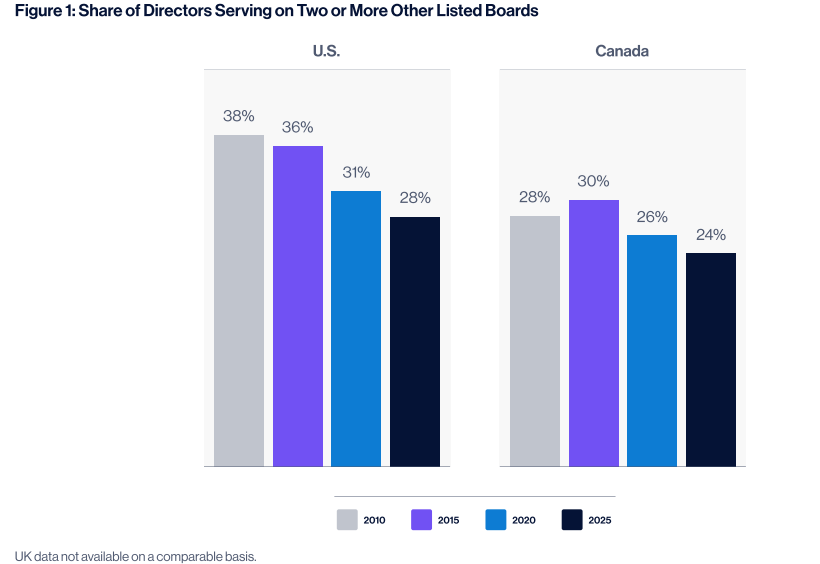
One director’s measure of the difference is that a board agenda that once cleared in half a day now takes a full day and a half. Directors are making room for the increasing demands too. In the U.S. and Canada, fewer now sit on two or more other boards than a decade ago (Figure 1).
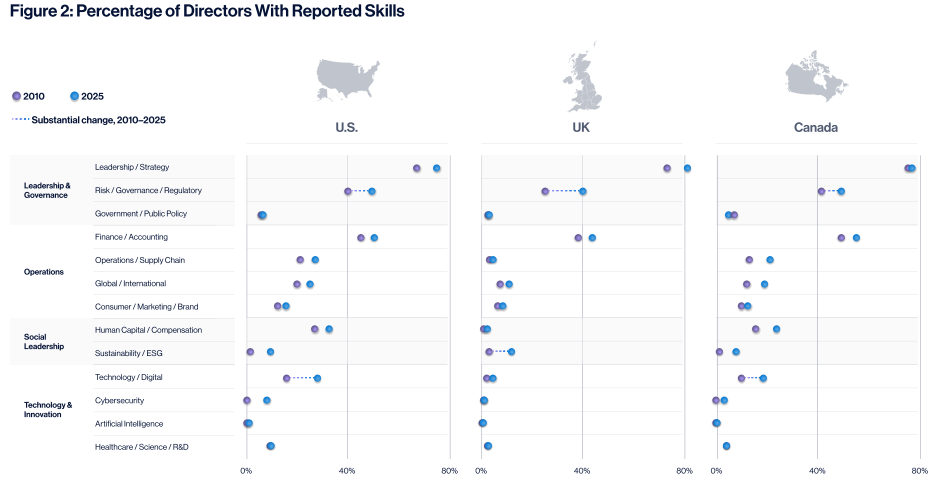
Board composition trends shine some light on the growing weight of oversight. Since 2010, risk, governance and regulatory expertise were among the fastest growing credited skills across the U.S., UK and Canada, steadily gaining ground on the leadership and strategy experience that has always defined the seat (Figure 2).
When directors reflect on the rising demands, they often focus on governance and oversight tasks because they resist compression. They have timelines, deadlines and a regulator who may read the minutes.
But near term pressures are displacing time for long term thinking. Strategy or growth discussions do not always have the same urgency, which makes corporate strategy the topic most likely to fall forward, or disappear, from agendas. Yet these are the discussions directors want to focus on. As agendas become consumed by near term issues, directors surveyed describe a pressing need to spend more time on questions that will shape the business tomorrow.
Directors acknowledge that the agenda is evolving faster than the operating model built to support it, and that they must evolve both how they work and what they focus on. Some are reopening fundamental questions. What should management address? Are committee structures fit for purpose? What are the demands of directors outside meetings?
Many say the search for capacity starts inside the meeting. Management tightens board materials so time together is spent interrogating content, rather than receiving it (one board cut presented content from 300 pages to 80). When the meeting adjourns, the work moves outside the boardroom, through briefings between cycles, committee chairs working directly with executives on specific areas, and directors building independent views on key issues rather than waiting for management.
Sharper content, more efficient meetings and more effective committees will create space for deeper discussion and sharper judgment. The new truth is that boards, and directors, must continually calibrate their function and focus in the face of new demands and an ever evolving operating environment.
In practice, Subtraction as board discipline
Board agendas are reaching their limits, and directors are reevaluating the fundamentals. Which topics no longer need the full board, which can move to prereads, and how much time is required for resolution. The approach will differ by company but the call to action is the same. How can boards continue to address mandatory oversight tasks to protect current value, while safeguarding strategic agenda time that positions the company for future growth and advantage?
Questions to consider
- What does the full board spend less time on than it did a year ago, and where has that work gone?
- Who decides which topics should receive less board time?
- Has our operating model kept pace with our agenda, and if not, which part needs reworking first?
Enter the Utility Player
An expanding agenda is not translating into an equally expanding board. Board sizes have not kept pace across the markets. U.S. boards have only added 1.5 seats over the past 15 years, while UK growth has been even more modest and Canadian boards have remained broadly the same size (Figure 3).
Faced with new demands, boards are asking more of the directors already around the table. Directors are now expected to offer broader expertise and contributions beyond the experience that first earned them the seat.
The shift is visible in board composition. Across the U.S., UK and Canada, directors are credited with more areas of expertise than 15 years ago (Figure 4). In the U.S., the average director is now credited with 3.5 areas of expertise, up from under 3, with Canada and the UK seeing a similar increase.
New capabilities are being layered onto the established requirements of the role, rather than replacing them. Risk and governance, technology and digital, and sustainability are among the fastest growing areas of expertise since 2010 (Figure 2), while traditional areas of finance, operations and leadership are holding ground. The cumulative effect is that a director role carries more skill expectations than it did 15 years ago.
Breadth of expertise is only part of what boards are looking for. The skills matrix records what a director has done; it is less able to capture the judgment that experience produces or how well that judgment carries forward. When directors describe what makes an effective board member, they point to how judgment shows up around the table. How they draw on relevant operating experience when confronting something new and offer insight beyond the area for which they were recruited. Directors describe this profile as the “utility player,” someone who brings depth in specific areas but also the versatility needed to impact a much broader agenda.
The value of that range becomes clearer as new demands emerge. AI is perhaps the clearest example, a rapidly evolving issue requiring fluency and judgment when the answers themselves are still developing.
In practice, The living matrix
The skills matrix gives boards a shared view of their collective expertise. But as the demands of directors evolve, a static matrix can quickly lose relevance. The challenge is not simply to fill capability gaps as they emerge, but to continually reassess whether the matrix reflects the capabilities the board now needs.
Questions to consider
- Relevance. Board priorities evolve, but skills are rarely removed from the matrix. Which skills would we still recruit for today?
- Currency. Expertise can become dated. How current are the skills represented across our board? How are we assessing ourselves as a board?
- Range. A matrix captures areas of expertise more easily than judgment and versatility. Does ours reflect the breadth of contribution we expect from directors?
Building AI Fluency in the Boardroom
Few board priorities today move faster, reach further or connect to more of the agenda than AI. Yet that speed is what makes subject matter expertise difficult to define and keep current. Even directors who have led enterprise wide AI implementations hesitate to describe themselves as “experts.” That tension is visible in the skills data.
AI is one of the least commonly reported areas of expertise across all three markets (Figure 2). On the surface that looks like a capability gap, but directors read it differently. For a technology evolving this quickly, the better measure is not how many directors are experts but whether the board has enough fluency to exercise judgment and the ability to access deeper expertise when needed.
Deep AI expertise, directors argue, can sit beside the board rather than permanently within it. Advisory boards, centers of excellence, management teams and external experts can provide specialist knowledge that can be refreshed as the technology evolves. On boards where deep AI experience is represented, directors are placing value on implementers who have deployed the technology in a business and understand its strategic and operational implications.
Fluency, however, must extend across the board. Directors need enough understanding to judge what AI means for the business, including where it creates opportunity, where it introduces risk, when it can be trusted and when management’s assumptions need to be challenged. That capability is required beyond AI for all new technologies, enabling directors to understand impacts, navigate opportunities and oversee disruption and potential risks.
The challenge is building fluency that can keep pace with the technology. Directors describe a range of approaches already being used across boards, including individual development budgets, immersion programs, pairing nonexecutives with senior managers and routine exposure to the technology itself. At one board, management runs three live AI demonstrations at every meeting, giving directors the opportunity to see the technology at work and sharpen the questions they ask. The approaches differ, but the responsibility is shared. Boards can provide dedicated support for learning, while directors remain accountable for keeping their own understanding current.
The Risk Between the Risks
Boards increasingly need to govern not only individual risks, but the connections between them. Geopolitical developments can quickly reshape the cyber threat landscape, while AI can amplify risks across cyber, data, fraud and operations.
These connections are testing traditional governance lines. Directors agree that overall oversight remains with the board, but there is no settled model for where accountability for specific issue resolution lies, whether with management, the audit or risk committee or the full board. One director asked 15 audit committee chairs how they govern, and received 15 different answers.
Some patterns do emerge. Where AI raises the stakes on an existing risk, such as data security or fraud, boards are systematically strengthening the controls already in place.
More broadly, boards are responding to the rising complexity of interconnected risks by placing greater emphasis on resilience rather than prediction, reading the risk register across, not down, to understand intersection points and evaluate management preparedness.
In practice, Fluency as a board discipline
AI fluency cannot be treated as a one off education exercise. Boards need a shared baseline of understanding, a way to keep that understanding current and access to deeper expertise when needed. The objective is not to make every director an AI expert, but to ensure the board can continue to exercise informed judgment as the technology evolves.
Questions to consider
- What should every director understand about AI to contribute effectively?
- How are we ensuring that understanding keeps pace with the technology?
- Where does the board turn when an issue requires expertise beyond its own?
Succession as a System
For directors, choosing who leads the company remains the board’s most consequential decision. The shift today is not its importance, but what it takes to get it right.
Boards once had more time to identify and prepare a successor who often looked much like the leader before them. Today, the pace of change means the leader a company needs in five years may look very different from the one it needs now. Directors describe leaders who are increasingly chosen for a particular phase of a company’s development rather than for a traditional longer term role.
The challenge facing boards is not only that they are planning for succession more often, with less time to identify and develop potential candidates. It is also that the role they are recruiting for keeps changing.
In response, boards are increasingly treating succession as a more dynamic and continuous system rather than an event, one that evolves with the business. Some directors describe looking earlier and more widely, building visibility into high potential leaders well before a transition comes into view. Others say they are extending their searches below the C suite to gain access to a wider talent pool.
But while boards are rethinking how they assess potential leaders, the harder challenge may be defining what they are assessing them against. The traditional succession model often starts with the role and a relatively static specification. A more dynamic approach starts with the future business. Where is the company going? What will be different about the strategy, operating model and competitive environment? And what leadership will that require? As those assumptions change, the leadership specification and succession pipeline need to change with them.
Where directors do align is that choosing the right leader is becoming less about the skills listed in their resume and more about the individual behind them. As the pace of business transformation quickens, boards increasingly need leaders who can perform when the ground shifts. Directors say they are relying more on how candidates operate in practice, how they adapt, respond under pressure and are viewed by colleagues and outside assessors.
In practice, Putting a system in play
Succession planning needs to keep pace with changing leadership demands. Mapping the market can show boards who is available today; the harder question is whether they are developing the pipeline the business may need tomorrow.
Questions to consider
- How early are we building visibility into potential successors, both internally and externally?
- How far below the C suite does our view of future leadership talent extend?
- What evidence do we have of how potential successors adapt, make decisions and perform under pressure?
Legal Disclaimer:
EIN Presswire provides this news content "as is" without warranty of any kind. We do not accept any responsibility or liability for the accuracy, content, images, videos, licenses, completeness, legality, or reliability of the information contained in this article. If you have any complaints or copyright issues related to this article, kindly contact the author above.
