

Resilient Power: Global Automotive Lead Acid Battery Market to Reach USD 52.40 Billion by 2035
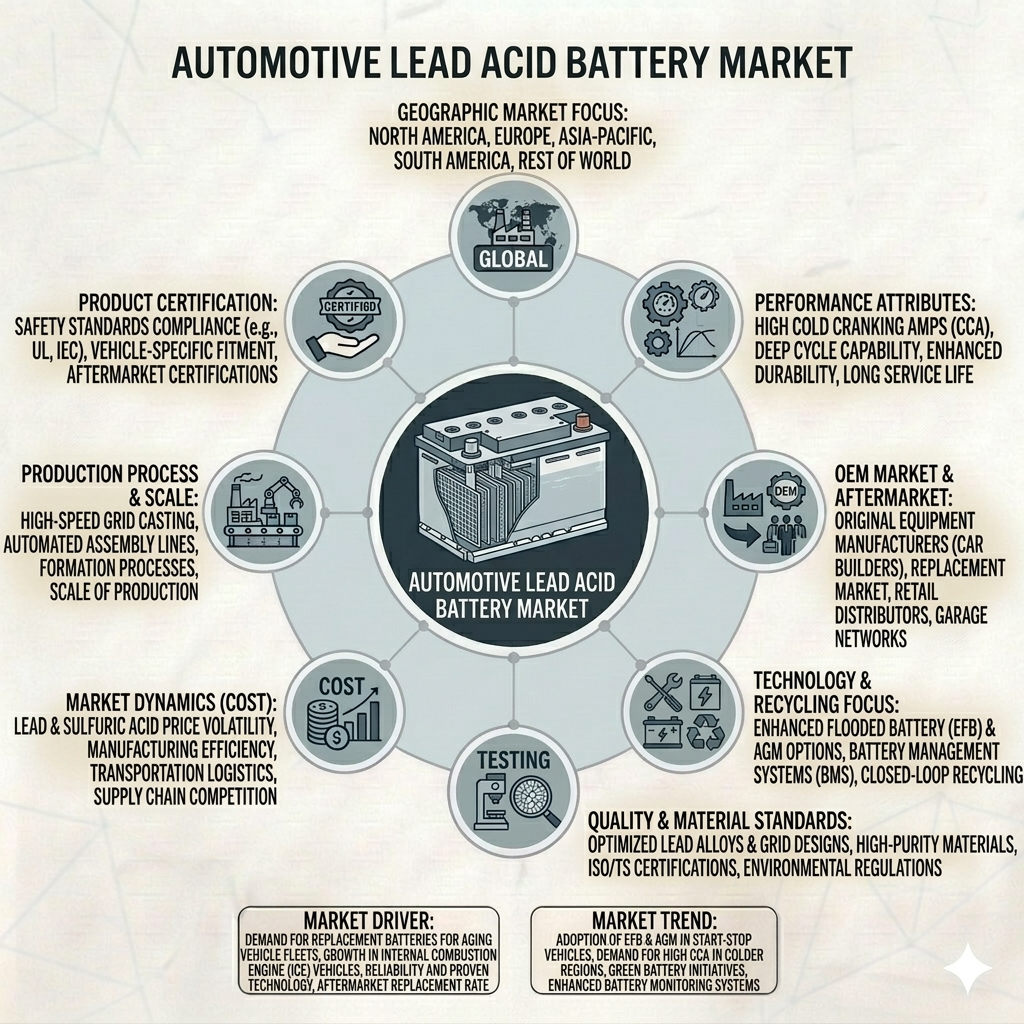
Automotive Lead Acid Battery Market Share
The Automotive Lead Acid Battery Market is projected to experience steady growth over the next decade, with a CAGR of 5.3% from 2025 to 2035.
NEWARK, DE, UNITED STATES, March 26, 2026 /EINPresswire.com/ -- The global transition toward electric mobility has not diminished the critical role of lead-acid technology. According to the latest 2026 strategic update, the Global Automotive Lead Acid Battery Market is valued at USD 31.3 billion in 2025 and is projected to reach USD 52.40 billion by 2035, growing at a steady CAGR of 5.3%.
While lithium-ion technology dominates high-voltage propulsion, lead-acid batteries remain the "gold standard" for 12V auxiliary power, safety-critical systems, and traditional Starting, Lighting, and Ignition (SLI) functions. The market is currently undergoing a "premiumization" phase, shifting from basic flooded batteries to advanced AGM (Absorbent Glass Mat) and EFB (Enhanced Flooded Battery) technologies required for modern start-stop and hybrid vehicles.
The Technology Split: Volume vs. Value
The market is bifurcated between the cost-effective reliability of traditional designs and the high-performance demands of micro-hybridization.
Key Segment Insights for 2026:
• Flooded Battery Dominance (60.0% Share): Traditional flooded batteries remain the volume leader, providing a cost-effective solution for the 1.5+ billion internal combustion engine (ICE) vehicles currently on the road. They are particularly dominant in the aftermarket replacement sector.
• AGM Technology (30.0% Share): Absorbent Glass Mat batteries are the fastest-growing segment. Essential for vehicles with regenerative braking and start-stop systems, AGM batteries offer 3-4x the cycling durability of conventional units and command a 40-60% price premium.
• The 12V Auxiliary Anchor: As EVs and autonomous vehicles proliferate, they still require a robust 12V lead-acid battery to bridge power gaps and support onboard electronics (infotainment, ADAS, and emergency lighting) when the main high-voltage pack is disengaged.
Get Access of Report Sample:
https://www.futuremarketinsights.com/reports/sample/rep-gb-1482
Market Drivers: The Aftermarket Engine
The lead-acid market is uniquely resilient because it is fueled by a predictable, recurring replacement cycle.
• Aftermarket Dominance: Unlike many automotive components, batteries are consumables with a 3-5 year lifespan. The aftermarket represents nearly 70% of total sales, providing a stable revenue stream that is largely insulated from fluctuations in new vehicle production.
• Start-Stop Standardization: Fuel efficiency regulations in the EU and China have made start-stop systems nearly universal in new ICE vehicles. This mandates a permanent shift toward EFB and AGM technologies, increasing the average revenue per unit for manufacturers.
• Closed-Loop Sustainability: Lead-acid batteries are the most recycled consumer product in the world, with a 99%+ recovery rate. This established circular economy provides a significant environmental and cost advantage over newer battery chemistries.
Regional Performance: North America and Asia-Pacific Lead
The regional growth of the automotive lead-acid battery market is anchored by a blend of massive existing vehicle fleets and the rapid adoption of high-performance battery technologies. The United States leads this expansion with a projected 5.4% CAGR, driven by a sprawling fleet of over 280 million units, an aging vehicle parc averaging 12 years, and extreme climate variances that accelerate battery replacement cycles. Both South Korea and the European Union follow closely with a 5.3% CAGR; while South Korea benefits from advanced OEM integration with brands like Hyundai and Kia and a powerful export-oriented manufacturing base, the European market is fueled by the near-total saturation of start-stop technology and high consumer penetration of premium AGM units.
In Japan, a 5.2% CAGR is sustained by the country’s world-renowned manufacturing excellence and its dominant leadership in providing auxiliary batteries for the global hybrid vehicle market. Meanwhile, India is projected to grow at a 5.0% CAGR, a trajectory supported by aggressive motorization trends and its status as the world’s largest replacement market for two-wheeler batteries.
Competitive Landscape: The Global Power Players
The market is moderately concentrated, with 15-20 players controlling over 60% of the global share. Competition is defined by distribution reach and the ability to manage raw material (lead) price volatility.
• Clarios (formerly Johnson Controls): The undisputed global leader, supplying 1 in 3 of the world's cars through brands like Varta and Optima.
• Exide Technologies: A powerhouse in both the OEM and aftermarket sectors, focusing on high-durability commercial vehicle applications.
• GS Yuasa: A leader in technology innovation, particularly in the Asian hybrid and start-stop markets.
• East Penn Manufacturing: Known for the Deka brand and its high-quality, privately-held manufacturing operations in the U.S.
Key Players:
• Clarios
• Exide Technologies
• GS Yuasa Corporation
• East Penn Manufacturing
• EnerSys
Executive Summary: The 2026 Strategy Roadmap
1. Capitalize on the "Auxiliary Shift": Manufacturers should market 12V lead-acid batteries as essential safety components for the EV transition, rather than just "starting" batteries.
2. Optimize the Aftermarket Omni-Channel: With more consumers buying batteries online, brands must strengthen partnerships with automotive retail chains (AutoZone, Advance Auto) and direct-to-consumer digital platforms.
3. Hedge Against Lead Volatility: Strategic investment in closed-loop recycling centers is essential to mitigate the impact of fluctuating raw material costs on profit margins.
Frequently Asked Questions (FAQ)
1. If EVs don't have engines, why do they need a lead-acid battery?
EVs use a high-voltage battery to move the car, but they still use a 12V lead-acid battery to power everything else—the headlights, the dashboard, the power steering, and the computer systems. It acts as a vital safety backup if the main battery fails.
2. What is the difference between EFB and AGM batteries?
EFB (Enhanced Flooded Battery) is an improved version of a standard battery, designed for basic start-stop cars. AGM (Absorbent Glass Mat) uses a glass fleece to soak up the acid, making it spill-proof, more durable, and better at handling the heavy electrical loads of luxury and high-tech vehicles.
3. Why is the United States market growing so steadily?
The U.S. has a very large number of older cars on the road (averaging 12 years). Since these cars need a new battery every few years, the replacement demand remains extremely high regardless of how many new cars are sold.
4. Can I replace a standard flooded battery with an AGM battery?
Yes, upgrading to an AGM battery is often recommended for better performance and lifespan. However, you should never replace an AGM battery with a standard flooded one if your car came with an AGM from the factory, as the standard battery will likely fail very quickly.
Brows More Industry Reports
Lead Acid Battery Market
https://www.futuremarketinsights.com/reports/global-lead-acid-battery-market
Lead Acid Battery Recycling Market
https://www.futuremarketinsights.com/reports/lead-acid-battery-recycling-market
Flooded Lead Acid Battery Market
https://www.futuremarketinsights.com/reports/flooded-lead-acid-battery-market
Sudip Saha
Future Market Insights Inc.
+1 347-918-3531
email us here
Legal Disclaimer:
EIN Presswire provides this news content "as is" without warranty of any kind. We do not accept any responsibility or liability for the accuracy, content, images, videos, licenses, completeness, legality, or reliability of the information contained in this article. If you have any complaints or copyright issues related to this article, kindly contact the author above.
