

FDA Foreign Inspection Gap Grows as U.S. Drug Imports Surge, New Study Finds
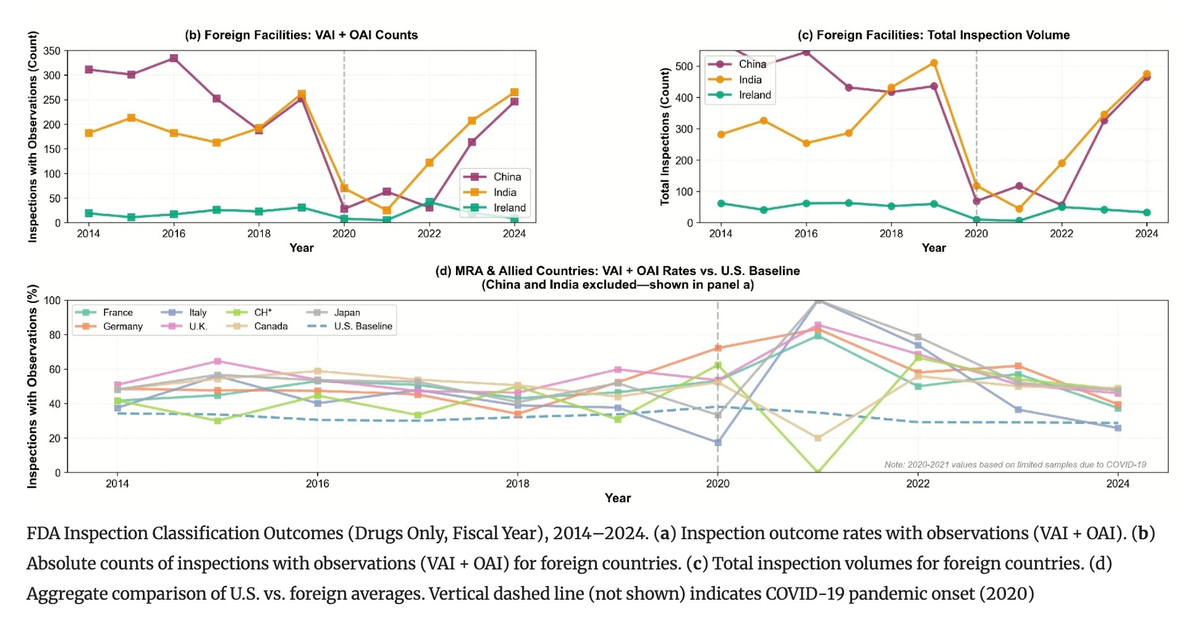
FDA GMP inspection counts and objectionable condition rates for China, India, and Ireland vs. the U.S. domestic baseline, 2014-2024. Foreign facilities failed inspections at 1.3 to 1.8 times the U.S. rate even with advance notice. Source: Journal of Pharm
Foreign facilities failed FDA GMP inspections at up to 1.8x the U.S. rate. Journal of Pharmaceutical Innovation study quantifies a decade of oversight gaps.
The research was conducted independently and received no external funding. Lead author George Kwiecinski is CEO and Founder of Global Key Solutions Corp., a regulatory intelligence company that operates as a Company in Residence at NYU Tandon Future Labs. Co-author Kevin Yuan is affiliated with the University of Wisconsin-Madison. The full published paper is available open access in the Journal of Pharmaceutical Innovation.
ABOUT THE RESEARCH
"The Foreign Inspection Gap: FDA GMP Oversight of U.S. Drug Imports, 2014-2024" analyzed more than 177,000 FDA inspection classification outcomes across ten major pharmaceutical-exporting nations over a ten-year study period. The study introduces a volumetric framework for measuring FDA GMP inspections per billion USD of pharmaceutical imports, a novel and replicable methodology for evaluating the effectiveness of foreign oversight relative to trade volume. This framework enables regulators, CDMOs, pharmaceutical manufacturers, biotech companies, and medical device quality and compliance teams to track whether enforcement resources keep pace with the global pharmaceutical trade. Beyond its immediate findings, the research introduces these methodologies to advance an open and ongoing dialogue among regulators, policymakers, and industry on the interrelated challenges of drug supply chain resilience, active pharmaceutical ingredient (API) sourcing and manufacturing abroad, inter-agency collaboration, and the modernization of Mutual Recognition Agreements and international GMP harmonization standards.
KEY FINDINGS
China's FDA inspection rate fell from 101.8 inspections per billion USD of pharmaceutical imports in 2014 to 18.3 in 2024, an 82% decline.
Inspection capacity did not scale with import growth. For every additional billion dollars of drug imports between 2014 and 2019, approximately 23 fewer FDA inspections were conducted. Reduced inspection frequency reflected resource constraints rather than improved facility compliance.
Foreign facilities fail at significantly higher rates. Analysis of 177,170 FDA inspection classification outcomes found that foreign facilities averaged a 61.9% rate of inspections with objectionable conditions (VAI plus OAI), compared to 49.3% for U.S. domestic facilities. China (69.0%) and India (62.3%) showed elevated rates that remained stable over time despite dramatic fluctuations in inspection volume.
The gap persists even with advance notice. Foreign facilities received weeks of advance notice yet still showed objectionable conditions at 1.3 to 1.8 times the U.S. domestic rate, suggesting unannounced inspections will likely reveal even higher non-compliance rates.
WHY THIS RESEARCH WAS PUBLISHED
The study addresses a critical gap in the literature on pharmaceutical regulatory intelligence. No prior peer-reviewed research had systematically quantified the inspection-to-import divergence across a ten-year longitudinal window using FDA enforcement data. The volumetric framework introduced here is designed to provide a forward-looking benchmark as the FDA continues modernizing its foreign inspection program.
The paper directly supports the policy context established by the FDA's May 2025 announcement of expanded unannounced foreign facility inspections: https://www.fda.gov/news-events/press-announcements/fda-announces-expanded-use-unannounced-inspections-foreign-manufacturing-facilities
The paper also addresses the BIOSECURE Act, incorporated into the National Defense Authorization Act (NDAA) for Fiscal Year 2026, which restricts federal contracting with foreign biotechnology entities of concern, including designated Chinese genomics and biomanufacturing firms, underscoring the national security and pharmaceutical supply chain resilience dimensions of the foreign oversight gaps documented in this research.
"This paper was designed to establish a novel, foundational methodology for how the regulatory community measures success in foreign pharmaceutical oversight. Regardless of what tools or policies are ultimately pursued, whether unannounced inspections, trade measures, Mutual Recognition Agreements, or information-sharing frameworks, we first need rigorous, replicable ways to define and track what success actually looks like. The relationships among GMP inspection volume, pharmaceutical import growth, and enforcement outcomes are deeply interconnected, yet they are not yet measured in ways that fully capture that complexity. Our goal was to begin that dialogue, to give researchers, regulators, and industry a common analytical foundation from which to evaluate what is working, what is not, and where the field needs to go next."
-- George Kwiecinski, Lead Author; CEO and Founder, Global Key Solutions Corp.
Pharmaceutical quality professionals, regulatory affairs teams, CDMOs, and researchers interested in contributing to ongoing research or providing feedback for future studies can access the submission form at the Global Key Solutions Corp. research page.
ABOUT THE AUTHORS
George Kwiecinski is CEO and Founder of Global Key Solutions Corp. and a graduate researcher at the University of Scranton. He is the author of a prior peer-reviewed publication in the Journal of Pharmaceutical Innovation on trends in FDA warning letter citations from 2019 to 2023. Global Key Solutions Corp. is a Company in Residence at NYU Tandon Future Labs. Kevin Yuan is affiliated with the University of Wisconsin-Madison.
ABOUT GLOBAL KEY SOLUTIONS CORP.
Global Key Solutions Corp. (GKS) is a regulatory intelligence company committed to transforming quality management in drug manufacturing through advanced software. GKS builds KeyPedia, an AI-powered platform that aggregates more than 1.5 million global regulatory data points, including warning letters, Form 483 inspection observations, facility inspection records, import refusals, and drug recalls, and is purpose-built for pharmaceutical, biotech, and medical device quality and compliance teams.
The regulatory landscape generates massive volumes of data across global agencies. The tools available to life science professionals have historically been unable to capture, interpret, or connect this data in meaningful ways, leaving quality and regulatory affairs teams to make critical compliance decisions without full visibility. GKS was built to change that. The company is headquartered in New York City and Scranton, Pennsylvania, and operates as a Company-in-Residence at NYU Tandon Future Labs.
Zephaniah Odidika
Global Key Solutions Corp.
email us here
Legal Disclaimer:
EIN Presswire provides this news content "as is" without warranty of any kind. We do not accept any responsibility or liability for the accuracy, content, images, videos, licenses, completeness, legality, or reliability of the information contained in this article. If you have any complaints or copyright issues related to this article, kindly contact the author above.
